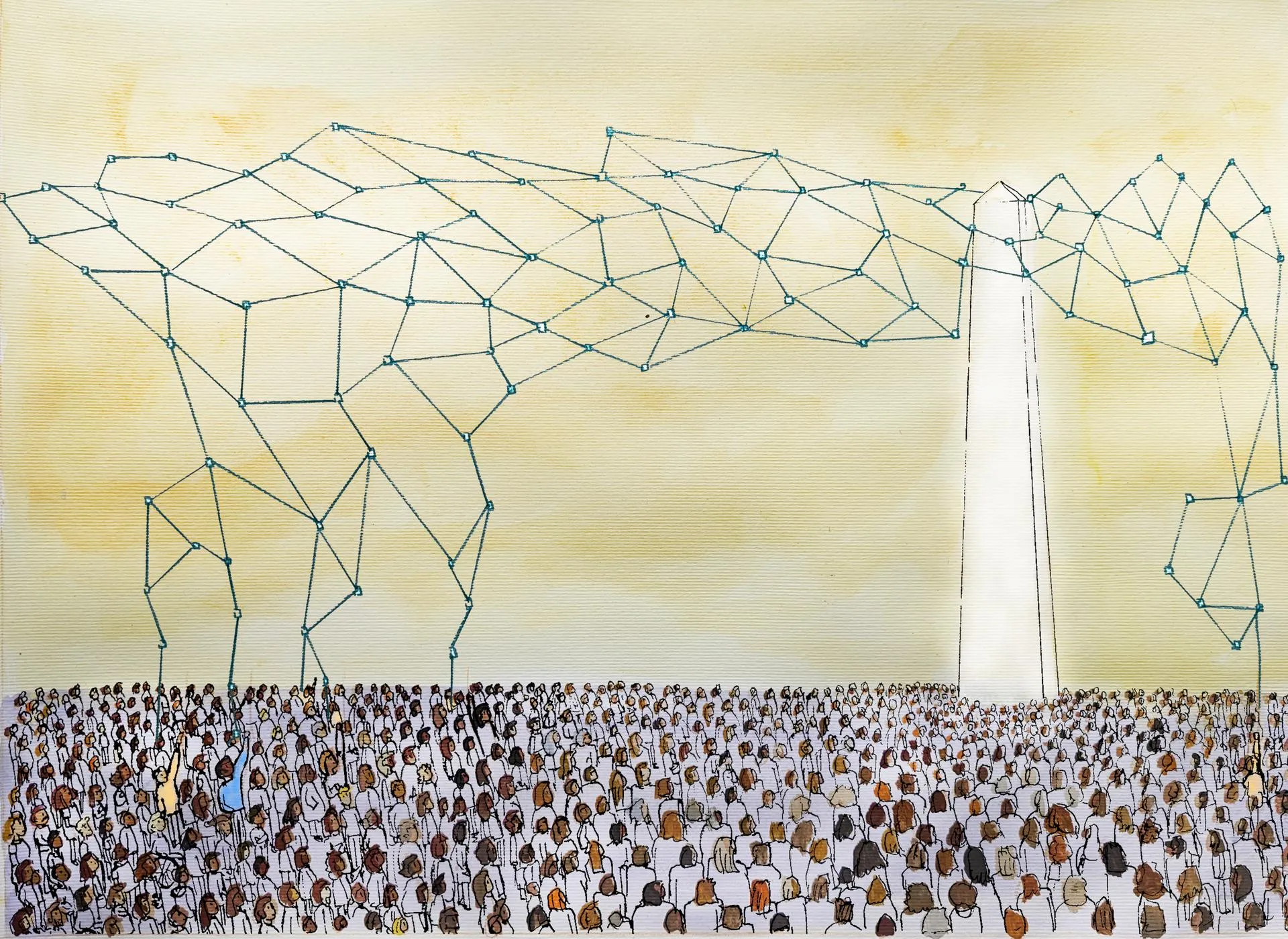
From resource depletion to mass surveillance, the true price of digital infrastructure is only beginning to be understood.
Environmental and Social Disadvantages
Data centers, the sprawling industrial facilities that power everything from streaming services and cloud storage to artificial intelligence, have become one of the most contentious land-use issues facing communities across the United States. These facilities, which house the servers and networking equipment that keep the digital world running, come with a staggering environmental and social price tag. A single hyperscale data center can consume as much electricity as 100,000 homes, while using between three and seven million gallons of water per day—enough to rival the water supply of a small town (Sidders, 2023; Moss, 2024). This immense resource draw is compounded by air quality concerns, as most facilities rely on diesel backup generators that emit 200 to 600 times more nitrogen oxides than modern natural gas plants, contributing to asthma and other respiratory illnesses in neighboring communities (Energy Innovation, 2024). Residents near proposed sites frequently cite disruptive noise levels reaching 96 decibels—as loud as a jackhammer—along with the irony that these high-tech hubs create very few permanent jobs, often employing only a few dozen specialized workers once construction is complete (Northern Virginia Residents Against Data Centers, 2025).
Data Centers as Surveillance Tools
Beyond their environmental and social toll, data centers function as powerful surveillance tools—a dimension of their operation that is rarely discussed in local zoning hearings. These facilities are not merely passive storage units; they are the physical backbone of mass data collection, enabling real-time monitoring of communications, financial transactions, location histories, and online behavior at an unprecedented scale (Zuboff, 2019). In many cases, data centers are designed to facilitate warrantless access by government agencies or to support predictive algorithms that profile citizens without their knowledge or consent (EFF, 2024). The very infrastructure that allows cloud providers to offer “free” services also allows for the aggregation and permanent retention of personal data, transforming every search, purchase, and conversation into a permanent record (ACLU, 2023). Furthermore, private companies operating these centers often retain the legal right to share or sell user data across borders, evading regional privacy protections (Klein, 2023). For communities hosting these facilities, this means becoming unwitting accomplices to a surveillance apparatus that extends far beyond their borders—with no local oversight, no public transparency, and no accountability for how the data of millions is ultimately used.
Who Is Pushing for Data Centers
Despite growing community backlash over resource consumption, noise pollution, and rising electricity bills, a powerful and well-funded coalition of interests is aggressively pushing for the rapid expansion of data centers across the United States. At the forefront are the world’s largest technology companies—Amazon, Google, Microsoft, Meta, and OpenAI—which are projected to spend $7 trillion on new data centers by 2030 to satisfy the computational demands of artificial intelligence (Bloomberg News, 2025). These tech giants are joined by an extensive network of industry trade associations, including the Data Center Coalition (DCC), which counts AWS, Google, Meta, and Oracle as members and nearly tripled its lobbying spending in a single quarter in 2025 (DCC, 2025; OpenSecrets, 2025). The Silicon Valley Leadership Group (SVLG) has launched a dedicated “Coalition on Innovation Infrastructure” to push for regulatory modernization and expanded data center capacity, while the newly formed National Artificial Intelligence Association (NAIA) is distributing talking points to members of Congress and organizing legislative field trips to active data centers to sway opinion in favor of the industry (SVLG, 2025; NAIA, 2025).
Utility companies are also major drivers: Edison Electric Institute spent $2.33 million on federal lobbying for “data center issues generally,” while companies like American Electric Power, Exelon, and Dominion Energy are pushing for policies that support data center load growth, as they stand to profit enormously from the increased electricity demand (EEI, 2025). Other industry beneficiaries include cooling and infrastructure firms like Ecolab, Siemens, and Bloom Energy, which are lobbying on data center efficiency and energy delivery issues (Bloom Energy & Ecolab, 2025).
Pro-data center forces also include a significant number of state and local political leaders who view these facilities as engines of economic development, tax revenue, and—in the context of the U.S.-China technology race—national security imperatives. Democratic Governors Gretchen Whitmer of Michigan and J.B. Pritzker of Illinois have both championed data center expansion, with Whitmer arguing that “if we don’t do them here, they’ll be done elsewhere, and they’ll be done less smart” (Whitmer, 2025). Republican Rep. Dusty Johnson of South Dakota has called blanket opposition to data centers “un-American” and “not at all capitalist,” framing the issue as a competition America must win against China (Johnson, 2025). These political leaders are supported by state-level economic development agencies and business councils—such as the Illinois Department of Commerce and the Detroit Regional Chamber—which actively recruit data center investment through generous incentive programs.
The Maryland Tech Council launched its Data Center Alliance of Maryland specifically to “educate Marylanders on the economic and fiscal contributions” of the industry, projecting that a single large facility could generate $775 million in economic activity during construction and $14 million annually in state tax revenue once operational (Maryland Tech Council, 2025).
In short, the push for data centers is not a grassroots movement but a coordinated, multi-billion-dollar campaign by tech giants, utilities, industry associations, and pro-business political leaders who see these facilities as essential to maintaining America’s technological and economic dominance—even as local communities increasingly demand accountability for the costs they impose.
Position of Digital Democracy Now
In light of these profound disadvantages—environmental, social, and civil liberties-based—our position is that data center development cannot continue under the current model of lax oversight and generous tax incentives. The rapid expansion of AI infrastructure is effectively privatizing profits while socializing the costs, shifting the burden of strained power grids, higher utility bills, environmental degradation, and systemic surveillance onto local residents and ratepayers. We support the growing movement of communities demanding a “smart growth” approach: mandatory independent studies on grid and water capacity, the replacement of diesel backups with battery storage, the end of tax abatements that leave towns footing the bill for infrastructure long after developers have moved on, and the inclusion of binding privacy and data governance agreements as a condition of approval. While data centers are essential to modern life, they should not be built on the backs of vulnerable communities or at the expense of fundamental rights. Any approval must be contingent on binding community benefits agreements, full transparency regarding resource usage and data handling practices, and the assurance that the digital future does not come at the expense of local health, financial security, or personal liberty.
References
Sidders, A. (2023, December 14). Data centers guzzle water and electricity. Neighbors are fighting back. The Washington Post.
https://www.washingtonpost.com/business/2023/12/14/data-centers-water-electricity-protests/
Moss, S. (2024, April 4). The secret cost of the cloud: Data center water usage. Data Center Knowledge.
https://www.datacenterknowledge.com/energy/the-secret-cost-of-the-cloud-data-center-water-usage
Energy Innovation Policy & Technology LLC. (2024, March 12). Diesel backup generators in data centers pose serious health risks to nearby communities.
https://energyinnovation.org/2024/03/12/diesel-backup-generators-data-centers-health-risks/
Northern Virginia Residents Against Data Centers. (2025). Noise pollution complaints and community testimony before Prince William County Board of Supervisors. Public record.
Zuboff, S. (2019). The Age of Surveillance Capitalism: The Fight for a Human Future at the New Frontier of Power. PublicAffairs.
Electronic Frontier Foundation (EFF). (2024, June 10). Data centers and the surveillance economy: How cloud infrastructure enables warrantless access.
https://www.eff.org/deeplinks/2024/06/data-centers-surveillance-economy
American Civil Liberties Union (ACLU). (2023, November 15). The hidden surveillance architecture of cloud computing.
https://www.aclu.org/news/privacy-technology/the-hidden-surveillance-architecture-of-cloud-computing
Klein, N. (2023, May 8). AI’s infrastructure is a surveillance machine. The Intercept.
https://theintercept.com/2023/05/08/ai-surveillance-data-centers/
Data Center Coalition (DCC). (2025, April 3). Q1 2025 lobbying disclosure reports filed with the U.S. Senate Office of Public Records.
https://www.opensecrets.org/federal-lobbying/clients/summary?cycle=2025&id=D000123456
OpenSecrets. (2025, February 18). Tech giants and utilities ramp up data center lobbying ahead of AI boom.
https://www.opensecrets.org/news/2025/02/data-center-lobbying-ai-boom/
Silicon Valley Leadership Group (SVLG). (2025, January 15). Coalition on Innovation Infrastructure: Policy blueprint for data center expansion in California.
https://www.svlg.org/innovation-infrastructure
National Artificial Intelligence Association (NAIA). (2025, March 10). Congressional briefing materials: Data centers as national security assets. (Internal talking points; summary available via Politico influence tracker.)
Whitmer, G. (2025, January 25). Remarks at the Michigan Economic Development Corporation data infrastructure summit. Lansing, MI. (Transcript via Michigan.gov.)
Pritzker, J.B. (2024, December 5). Press conference announcing data center tax incentive expansion. Illinois Department of Commerce and Economic Opportunity. Springfield, IL.
Johnson, D. (2025, February 12). Interview on “The Hugh Hewitt Show.”
https://hughhewitt.com/interviews/2025/02/12/rep-dusty-johnson-data-centers/
Maryland Tech Council. (2025, April 20). Data Center Alliance of Maryland: Economic impact projections for a 250MW facility.
https://www.mdtechcouncil.org/data-center-alliance
Edison Electric Institute (EEI). (2025, January 30). Federal lobbying disclosure for “data center load growth and grid modernization.” U.S. Senate Office of Public Records.
Bloom Energy Corp. & Ecolab Inc. (2025, March 5). Joint letter to the Federal Energy Regulatory Commission (FERC) regarding data center energy infrastructure. Docket No. AD25-1-000.
General and Financial Data
McKinsey & Company. (2024, October). Investing in the rising data center economy.
https://www.mckinsey.com/industries/technology-media-and-telecommunications/our-insights/investing-in-the-rising-data-center-economy
Bloomberg News. (2025, January 10). Tech’s $7 trillion data center spending spree.
https://www.bloomberg.com/news/articles/2025-01-10/tech-s-7-trillion-data-center-spending-spree